
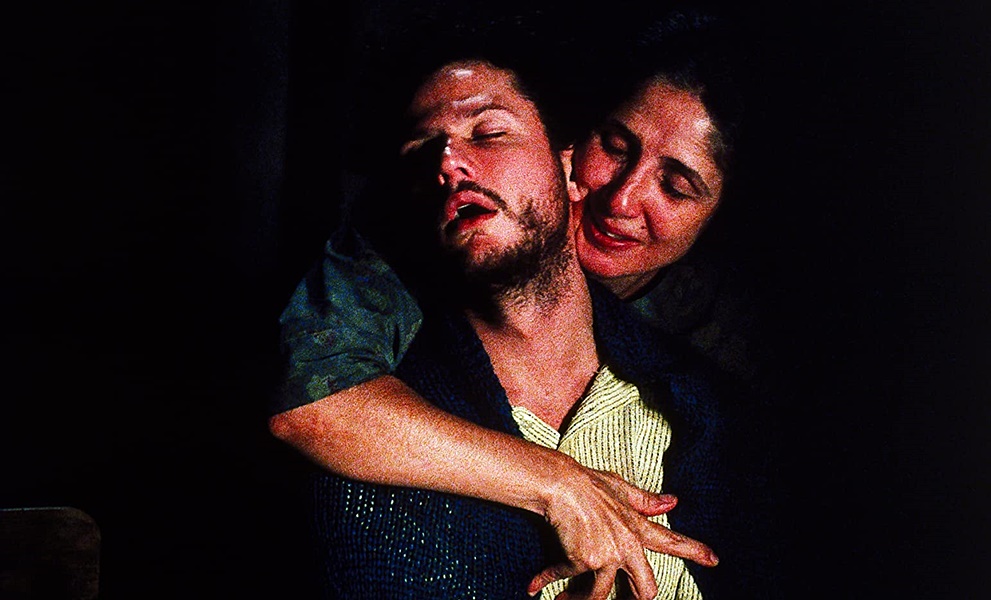
🎬 Lavoura Arcaica (2001) – AKA To the Left of the Father
📅 Release Year: 2001
🌍 Country: Brazil
🎭 Genre: Drama
⏱ Duration: 163 min
🎬 Director: Luiz Fernando Carvalho
📖 Storyline
Lavoura Arcaica (2001) is an intense and poetic family drama centered on André, a young man who returns to his deeply traditional rural family after a long absence. His homecoming reopens emotional wounds tied to rigid patriarchal authority, religious devotion, and forbidden desire.
As André recounts his past through fragmented memories and lyrical monologues, the film explores the suffocating weight of tradition and the internal conflict between obedience and personal freedom. The story unfolds as a psychological and emotional reckoning, where love, guilt, and rebellion collide within the boundaries of family and faith.
🎥 Movie Details
Original Title: Lavoura Arcaica
Language: Portuguese
Subtitles: English
Release Date: 2001
Setting: Rural Brazil
Production: Brazilian cinema
🎭 Cast
Selton Mello as André
Raul Cortez as The Father
Simone Spoladore as Ana
Leonardo Medeiros
Caio Blat
⭐ Review & Analysis
Lavoura Arcaica is a visually striking and emotionally demanding film, known for its lyrical language and symbolic imagery. Director Luiz Fernando Carvalho adapts Raduan Nassar’s novel with a bold, experimental approach, blending literature, theater, and cinema into a unique narrative form.
Selton Mello delivers a deeply internalized performance, conveying anguish and desire through voice and expression rather than action. The film stands out for its exploration of repression, identity, and the destructive power of absolute authority, making it one of the most distinctive works in Brazilian cinema.
🎯 Why Watch This Movie – An In-Depth Look at Lavoura Arcaica (2001)
✔ Powerful literary adaptation with poetic intensity
✔ Visually expressive and unconventional storytelling
✔ Deep exploration of family, faith, and repression
✔ Strong performances and emotional depth
Released in 2001, Lavoura Arcaica (To the Left of the Father) is not a film that asks for easy attention. It demands patience, emotional openness, and a willingness to sit with discomfort. Directed by Luiz Fernando Carvalho and adapted from Raduan Nassar’s celebrated novel, the film occupies a unique place in Brazilian cinema—revered by critics, rarely discussed by mainstream audiences, and often misunderstood by first-time viewers.
At its core, Lavoura Arcaica is a story about family, repression, and desire, but describing it in simple narrative terms does not do justice to its impact. The film is structured less like a traditional drama and more like a memory unfolding. Time bends, dialogue becomes poetic rather than functional, and images carry as much meaning as words. This is a film that feels lived rather than explained.
The story follows André, a young man who abandons his deeply traditional rural family and later returns, confronting his father’s rigid moral authority and the emotional scars left behind. The father represents order, discipline, and religious devotion, while André embodies impulse, longing, and rebellion. Their conflict is not merely generational—it is philosophical. One side believes life must be controlled; the other believes life must be felt.
What makes Lavoura Arcaica so unsettling is not just its subject matter, but the way it is presented. Carvalho uses long takes, whispered monologues, and fragmented editing to place the viewer inside André’s inner world. Scenes often feel intimate to the point of intrusion, as if the audience is witnessing something they were never meant to see. This discomfort is deliberate. The film refuses to provide emotional distance.
Visually, Lavoura Arcaica is striking. Shot with warm, earthy tones, the rural setting feels both nurturing and suffocating. The family home is not portrayed as a safe haven, but as a space of constant observation and unspoken rules. Meals, prayers, and family gatherings are loaded with tension. Silence becomes as powerful as dialogue, and small gestures carry enormous weight.
One of the film’s most discussed elements is its exploration of forbidden desire. Rather than sensationalizing it, Carvalho approaches the subject with restraint and ambiguity. The emotions involved are portrayed as inevitable rather than shocking, rooted in isolation, repression, and emotional dependency. This approach unsettles viewers precisely because it avoids clear moral signposting. The film does not instruct the audience on what to feel—it forces them to confront their own reactions.
Religion plays a central role in shaping the family’s worldview. The father’s sermons are delivered with conviction, emphasizing sacrifice, patience, and obedience. Yet these ideals, when imposed without compassion, become instruments of control. André’s rebellion is not against faith itself, but against its weaponization. The film suggests that spirituality, when stripped of empathy, can become destructive rather than sustaining.
Unlike many family dramas, Lavoura Arcaica offers no clean resolution. The return home does not bring healing in the conventional sense. Instead, it exposes wounds that were never allowed to surface. The past is not something that can be corrected—it must be endured. This refusal to offer closure is one reason the film lingers long after it ends.
The performances are central to the film’s power. Selton Mello’s portrayal of André is intense yet controlled, conveying turmoil through subtle shifts in expression rather than overt dramatics. Raul Cortez, as the father, embodies authority with a quiet, unyielding presence. Their scenes together are charged, not because of raised voices, but because of everything left unsaid.
When Lavoura Arcaica was released, it divided audiences. Some praised it as a masterpiece of Brazilian cinema; others found it impenetrable and emotionally exhausting. Over time, however, its reputation has grown. It is now frequently cited in academic discussions of Latin American cinema, particularly in analyses of masculinity, family structure, and the legacy of patriarchal authority.
The film’s relevance has not faded. In an era where conversations about emotional repression, generational trauma, and rigid moral systems are more visible than ever, Lavoura Arcaica feels quietly contemporary. Its questions remain unresolved: How much control can a family exert before love turns into confinement? Can tradition coexist with individual freedom? And what happens when desire is treated as a threat rather than a human reality?
Watching Lavoura Arcaica is not a comfortable experience, and it is not meant to be. It is a film that resists casual consumption, asking instead for reflection and emotional honesty. For viewers willing to engage with its rhythm and ambiguity, it offers something rare: a cinematic experience that feels both deeply personal and universally unsettling.
This is not a film that explains itself. It stays with you precisely because it refuses to.
🎬 Similar Movies
The House of the Spirits (1993) — Family, memory, and tradition
Festen (1998) — Family conflict and buried truths
Padre Padrone (1977) — Patriarchal control and personal rebellion
Novecento (1976) — Tradition, power, and generational struggle
❓ FAQ
Is this film based on a novel?
Yes. It is adapted from the novel Lavoura Arcaica by Raduan Nassar.
Is the film difficult to watch?
It can be challenging due to its slow pace, dense dialogue, and emotional intensity.
Does it focus on religion?
Religion plays a strong role as part of the family’s moral and cultural structure.
Is it a conventional drama?
No. It is highly stylized and poetic, prioritizing mood and language over linear storytelling.
⇓ DOWNLOAD OPTIONS ⇓
Lavoura Arcaica (2001)_HD.mp4 – 3.7 GB
💥💥💥
📂🎞️ Rare Movies Download Folder
🔥🔥🔥
Related posts:
 Yurîka (2000) AKA Eureka
 Swing High, Swing Low (1937)
 Petrolejové lampy (1971) AKA Oil Lamps
 Praznik (1967) AKA The Feast
 Black Girl (1972)
 Stanno tutti bene (1990) AKA Everybody’s Fine
 Genji monogatari (1951) AKA The Tale of Genji
 Metti, una sera a cena (1969) AKA Love Circle
 Welcome to Dongmakgol (2005) AKA Battle Ground 625, 웰컴 투 동막골
 Yol (1982) AKA The Way / The Road
 Bu su (1987)
 Les filles ne savent pas nager (2000) AKA Girls Can’t Swim